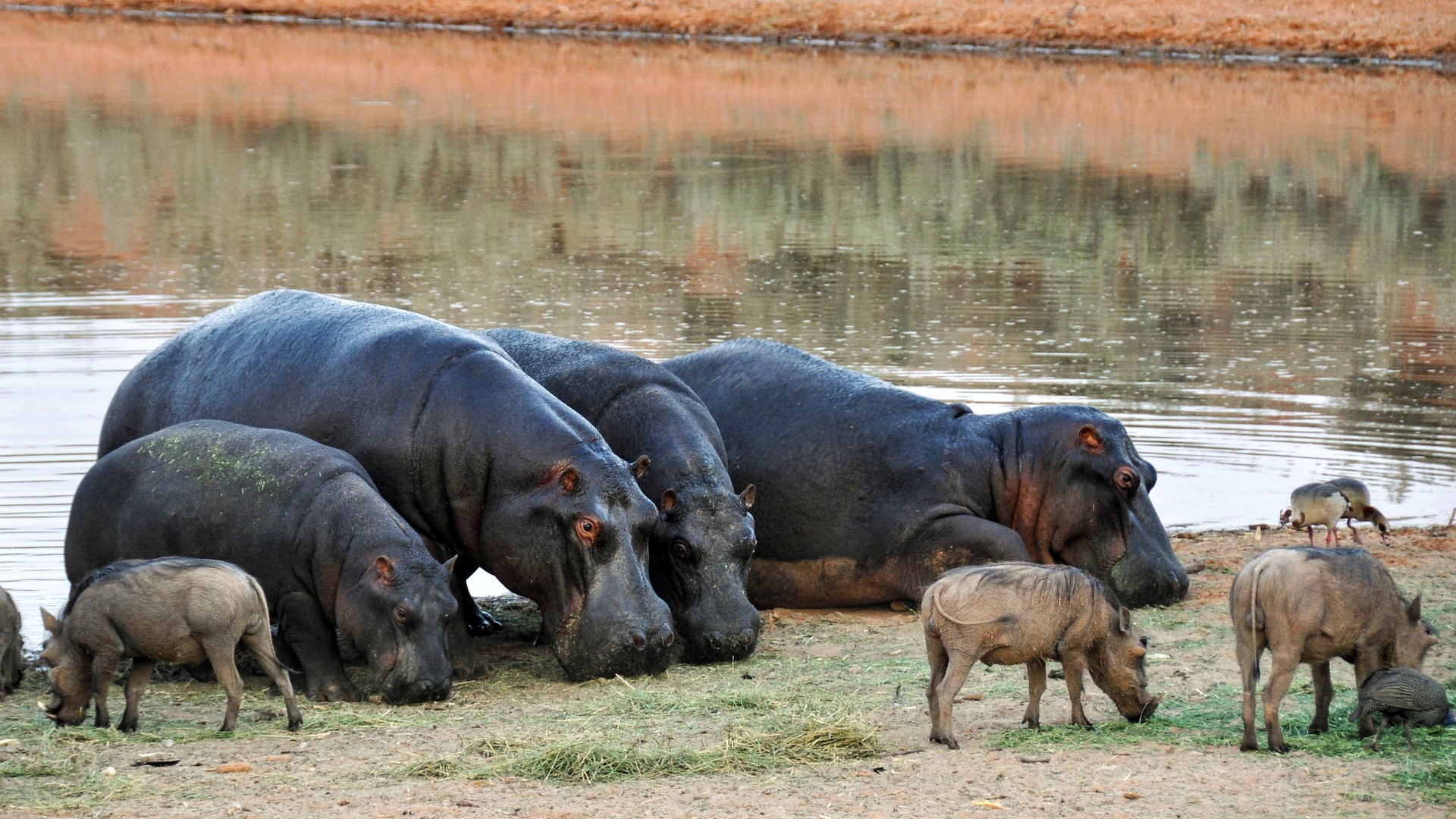
Hippopotamus on a waterhole in Namibia.
This image is released under Creative Commons CC0. Copyright and related or neighboring rights to this image has been waived. You are free to adapt and use for commercial purposes without attributing the original author or source. Although not required, a link back is appreciated.
A hippopotamus also known as a hippo is a large animal. Its name derives from the ancient Greek for river horse and is native to sub-Saharan Africa, and one of only two extant species in the family Hippopotamidae, the other being the pygmy hippopotamus. Two hippo species are found in Africa. The large hippo, found in Kenya, Uganda, Tanzania and Southern Africa. The other, much smaller (440 to 605 pounds) species of hippo is the pygmy hippopotamus. Limited to very restricted ranges in West Africa, it is a shy, solitary forest dweller and is now rare.
Hippopotamuses love water, which is why the Greeks named them the “river horse.” Hippos spend up to 16 hours a day submerged in rivers and lakes to keep their massive bodies cool under the hot African sun.
Can Hippos Breathe Underwater
No hippos can’t breath underwater. They can hold their breath underwater for upto five minutes and this is what enables then to stay and even sleep in the water. Their eyes and nostrils are located high on their heads, which allows them to see and breathe while mostly submerged.
Can Hippos Swim
Hippos can’t swim or float. Their bodies are far too dense to float, to allow them to float. They however move around by pushing off from the bottom of the river or pond or simply walking along the riverbed in a slow-motion gallop.
Hippos also bask on the shoreline and secrete an oily red substance, which gave rise to the myth that they sweat blood. The liquid is actually a skin moistener and sunblock that may also provide protection against germs.
At sunset, hippopotamuses leave the water and travel overland to graze. They may travel 6 miles in a night, along single-file pathways, to consume some 80 pounds of grass. Considering their enormous size, a hippo’s food intake is relatively low. If threatened on land hippos may run for the water—they can match a human’s speed for short distances.