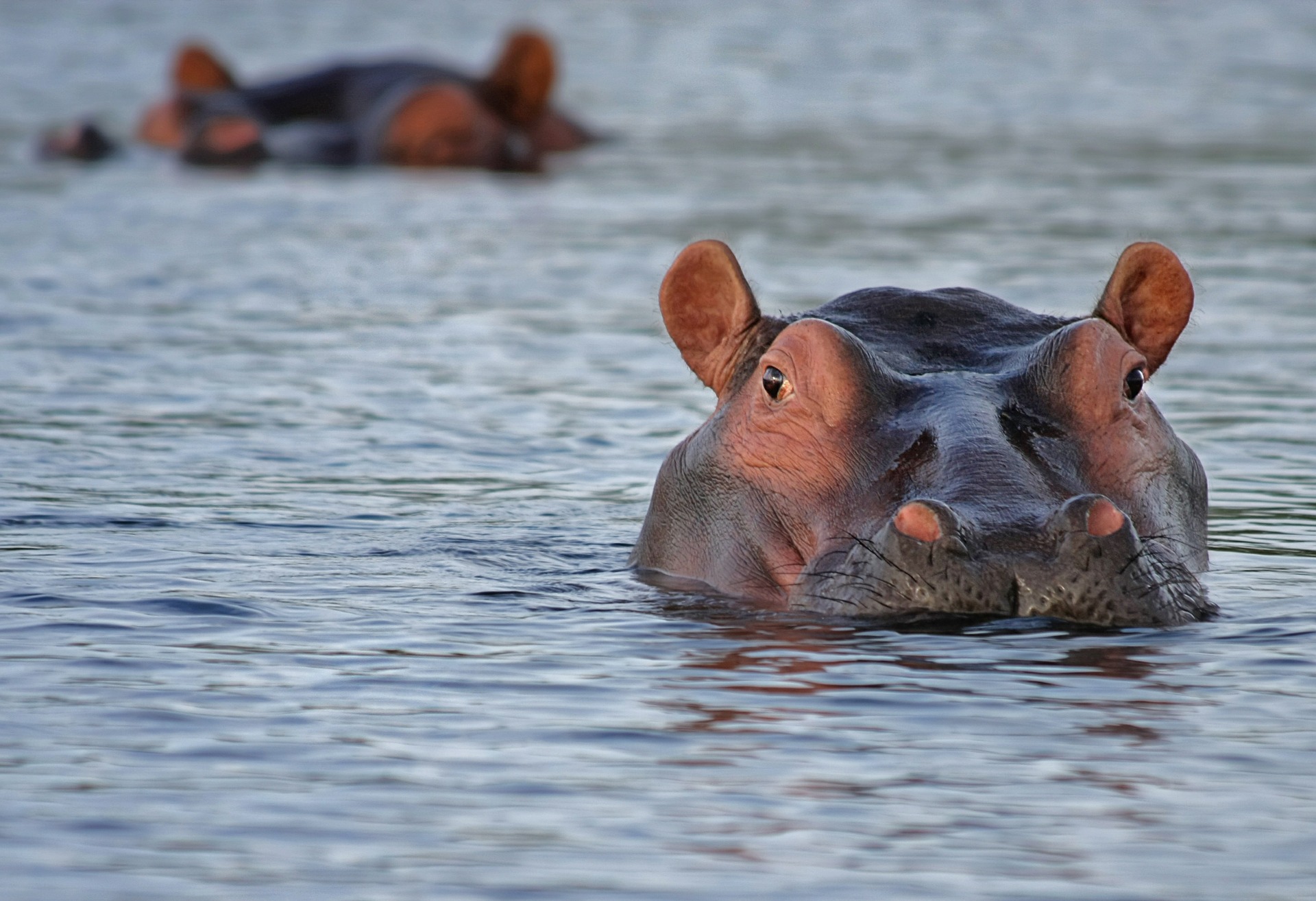
A hippo surfaces on a pond.
This image is released under Creative Commons CC0. Copyright and related or neighboring rights to this image has been waived. You are free to adapt and use for commercial purposes without attributing the original author or source. Although not required, a link back is appreciated.
The hippopotamus has a bulky body on stumpy legs, an enormous head, a short tail, and four toes on each foot. Each toe has a nail-like hoof. Males are usually 3.5 metres (11.5 feet) long, stand 1.5 metres (5 feet) tall, and weigh 3,200 kg (3.5 tons). In terms of physical size, males are the larger sex, weighing roughly 30 percent more than females. The skin is 5 cm (2 inches) thick on the flanks but thinner elsewhere and nearly hairless. Colour is grayish brown, with pinkish underparts. The mouth is half a metre wide and can gape 150° to show the teeth. The lower canines are sharp and may exceed 30 cm (12 inches).
Hippos are well adapted to aquatic life. The ears, eyes, and nostrils are located high on the head so that the rest of the body may remain submerged. The ears and nostrils can be folded shut to keep out water. The body is so dense that hippos can walk underwater, where they can hold their breath for five minutes. Although often seen basking in the sun, hippos lose water rapidly through the skin and become dehydrated without periodic dips.
They must also retreat to the water to keep cool, for they do not sweat. Numerous skin glands release an oily reddish or pinkish “lotion,” which led to the ancient myth that hippos sweat blood; this pigment actually acts as a sunblock, filtering out ultraviolet radiation.